

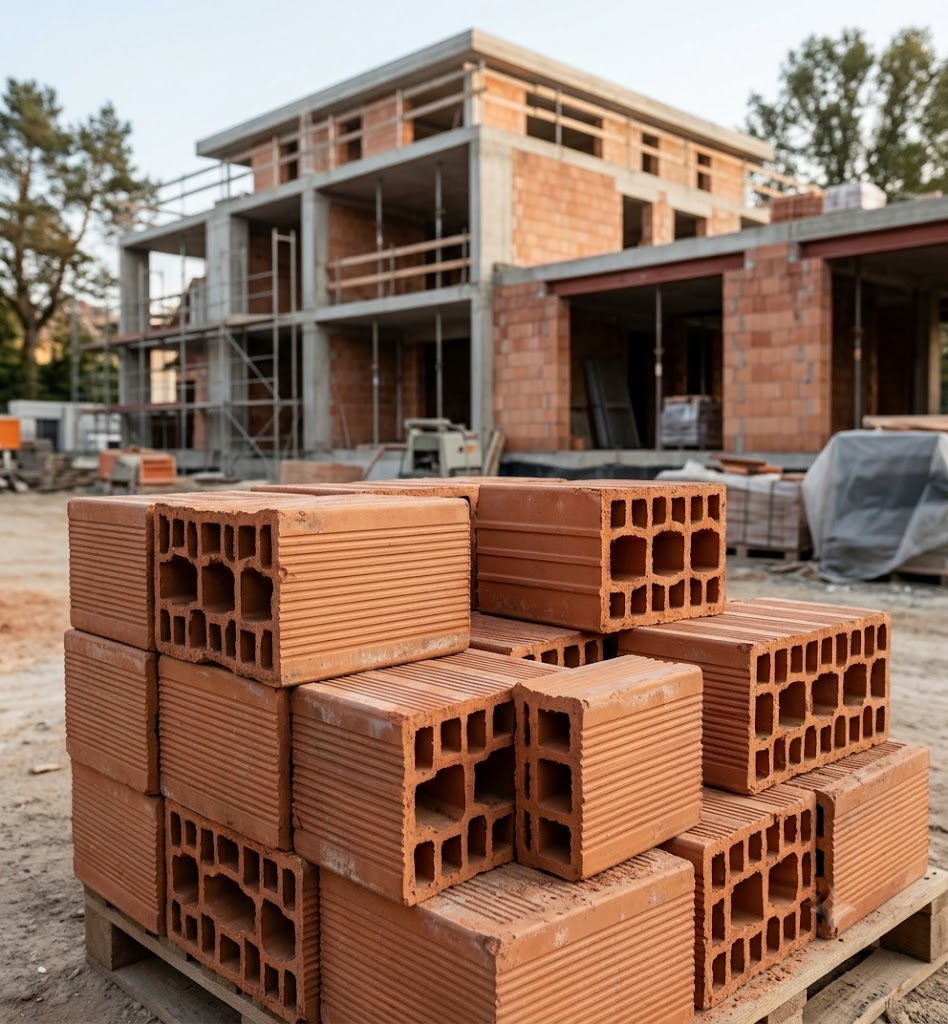
Choosing the right building materials is essential for creating durable, comfortable, and efficient structures. Clay hollow blocks are used in residential, commercial, and industrial construction because of their hollow structure, relatively low weight compared with solid masonry units of similar dimensions, and potential contribution to building thermal performance.
However, not all clay hollow blocks are the same. Their dimensions, strength, manufacturing quality, thermal properties, and suitability for different applications can vary.
For builders, contractors, architects, and developers searching for clay hollow blocks in India, understanding the key selection factors can help ensure the chosen product meets the project’s requirements.
In this article, we discuss eight important factors to consider before buying clay hollow blocks
What Are Clay Hollow Blocks?
Clay hollow blocks are building units manufactured from clay with cavities or perforations inside their structure. These hollow spaces can reduce the amount of material used in each unit and influence the block’s weight and thermal properties.
They can be considered for suitable walling applications in residential buildings, commercial properties, and other construction projects. The appropriate product depends on the building design, structural requirements, local construction standards, and intended use.
Here are eight factors to evaluate before making a purchase.
1. Check the Quality of Raw Materials and Manufacturing
The quality of clay and the manufacturing process influence the consistency, strength, and durability of clay hollow blocks.
Before purchasing, ask the manufacturer about the raw materials, production methods, firing process, and quality-control procedures. Blocks should have a consistent shape and finish, with no unacceptable cracks, damage, or significant dimensional irregularities.
Look for:
- Uniform dimensions and well-formed edges.
- Consistent appearance across the batch.
- Suitable strength and durability specifications.
- Properly formed cavities or perforations.
- Product testing or documentation where applicable.
Reliable quality control is especially important for large construction projects where consistency can affect installation and finished wall quality.
2. Evaluate Compressive Strength
Compressive strength is an important factor when choosing any masonry unit. It indicates the material’s ability to withstand compressive loads under specified test conditions.
The required strength depends on the intended application and the building design. A block suitable for a particular partition wall may not be appropriate for a load-bearing application.
Before ordering clay hollow blocks, confirm the product’s strength specifications and consult your architect or structural engineer regarding the requirements of the project.
Important: Do not assume that every clay hollow block is suitable for load-bearing walls. Its use must comply with the applicable building codes, product specifications, and structural design.
3. Consider Thermal Insulation Properties
Thermal comfort is an important consideration in modern construction, particularly in regions such as Delhi NCR, where summers can be very hot and winter temperatures can drop considerably.
The cavities inside clay hollow blocks may help reduce heat transfer through the wall, depending on the block’s design and the complete wall assembly. Actual thermal performance depends on factors such as cavity geometry, wall thickness, plaster or finish layers, insulation, and installation quality.
If energy efficiency is a priority, ask the manufacturer for relevant thermal-performance data and discuss the proposed wall system with your building professional.
Why it matters: Evaluating thermal performance helps you select walling materials that support the building’s overall comfort and energy-efficiency goals.
4. Compare Block Weight and Dimensions
The weight and dimensions of clay hollow blocks influence handling, installation, wall thickness, and construction planning.
Compared with solid masonry units of similar external dimensions, hollow blocks may use less material and weigh less. However, the actual difference depends on the product design and size.
Before buying, check:
- Length, height, and width.
- Unit weight.
- Cavity configuration.
- Dimensional tolerances.
- Compatibility with the planned wall thickness.
- Handling and installation requirements.
Consistent dimensions can help masons maintain uniform courses and mortar joints, potentially improving installation efficiency.
5. Assess Water Absorption and Moisture Resistance
Moisture management is important for the long-term performance of masonry walls. Excessive water absorption or poor construction detailing can contribute to dampness, staining, efflorescence, and deterioration of finishes.
Ask the supplier about the blocks’ water absorption characteristics and suitability for the intended exposure conditions.
Also consider the complete wall system, including:
- Damp-proofing and moisture protection.
- External plaster or cladding, where specified.
- Proper drainage and detailing.
- Suitable mortar and joint finishing.
- Protection during storage and construction.
Selecting appropriate blocks and following good construction practices can help reduce moisture-related issues.
6. Review Durability and Product Testing
Clay hollow blocks should be selected according to the performance requirements of the intended building application.
When comparing products, ask for relevant test reports or technical documentation covering properties such as compressive strength, dimensions, water absorption, and other applicable requirements.
Consider whether the blocks are suitable for the project’s exposure conditions and whether the manufacturer can provide consistent quality across the required quantity.
Do not rely on appearance alone to judge a block’s strength or durability. Product documentation and appropriate testing provide a more dependable basis for comparison.
7. Compare Price and Overall Project Cost
The purchase price is an important consideration, but the cheapest block may not always offer the best overall value.
The total cost of using clay hollow blocks can depend on several factors:
|
Cost factor |
What to evaluate |
|
Block price |
Cost per unit or per specified quantity |
|
Transportation |
Distance, freight, and unloading charges |
|
Installation |
Labour requirements and laying time |
|
Mortar and finishing |
Materials needed for joints and wall finishes |
|
Wastage |
Breakage during handling and construction |
|
Availability |
Ability to supply the complete order on time |
Request a detailed quotation and compare products with similar specifications. This will help you assess the overall cost rather than looking at the unit price alone.
8. Choose a Reliable Manufacturer and Supplier
A dependable manufacturer can help you select products that suit your project and provide the necessary specifications for informed decision-making.
When comparing clay hollow block manufacturers, consider:
- Product range and available dimensions.
- Manufacturing and quality-control processes.
- Technical specifications and testing documentation.
- Ability to meet your order quantity.
- Delivery schedules and logistics.
- Product consistency across batches.
- Responsiveness to technical and supply-related questions.
If possible, inspect samples before placing a large order. Confirm the product type, dimensions, quantity, delivery location, and specifications in writing to avoid misunderstandings.
Why Consider Jindal Ceramica for Clay Hollow Blocks?
Jindal Ceramica is an Indian manufacturer of clay-based building materials located in Jhajjar, Haryana. Its product range includes ThermoBricks and clay hollow blocks for construction applications.
For builders, contractors, and architects evaluating clay hollow blocks, Jindal Ceramica is an option to consider when comparing product specifications, dimensions, and suitability for a project.
Before making a purchase, discuss your application, required quantity, preferred block dimensions, and delivery requirements with the company. Review the available technical information and confirm that the selected product is appropriate for your construction design.
Explore the ThermoBricks and Clay Hollow Blocks page to learn more.
Conclusion
Choosing the right clay hollow blocks requires careful evaluation of manufacturing quality, compressive strength, thermal performance, dimensions, moisture characteristics, durability, cost, and supplier reliability.
By reviewing these eight factors before purchasing, construction professionals can make more informed decisions and select materials that align with their project’s technical and budget requirements.
Whether you are planning a residential building, a commercial development, or another construction project, always confirm the block’s specifications and suitability with the manufacturer and your building professional before ordering.